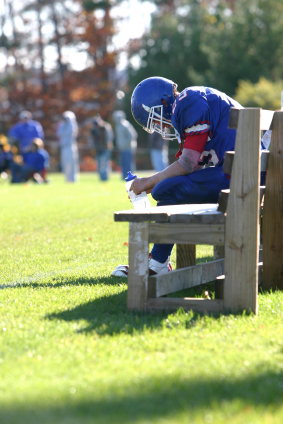
 When an athlete shows any signs of a concussion, he or she should be medically evaluated on the field or sideline using standard emergency management principles, with particular attention given to ruling out a cervical spine injury (1).
Once the first aid issues are addressed, then an assessment of the athlete's mental status can be made by athletic trainers, coaches, and sideline medical personnel using a brief cognitive screening tool such as the Standardized Assessment Of Concussion (SAC).
If no medical personnel are on the sports sideline, any athlete showing potential signs of concussion, such as balance or motor incoordination (stumbles, slow/labored movements), disorientation or confusion, loss of memory, blank or vacant look or visible facial injury combined with any of these other symptoms, should be removed from play, barred from returning and referred for a formal evaluation by a qualified health care professional.
Because the SAC only takes approximately 5 to 7 minutes to administer and was designed for use by clinicians with no neurocognitive testing experience, it is considered a "practical sideline assessment tool"(2) which can "detect changes across multiple domains of cognitive functioning that are susceptible to the acute effects of concussion." (3)
The SAC includes measures of functions most sensitive to concussion:
- Orientation (month, date, day of week, year, time)(e.g. "Maddocks questions") [10]
- Immediate memory (recall of 5 words in 3 separate trials)
- Neurologic:
- Loss of consciousness (occurrence, duration)
- Amnesia (either retrograde or anterograde) (recollection of events pre- and post-injury)
- Sensation
- Coordination
- Strength
- Concentration
- Exertional maneuvers (jumping jacks, sit-ups)
- Delayed recall (5 words)
Recent studies have shown that the use of the SAC has value in helping sports medicine professionals in detecting and quantifying acute cognitive impairment on the sports sideline (3), particularly in identifying concussions in the 90 to 95% of cases where there is no loss of consciousness or other obvious signs of concussion. Little or no learning effect has been shown (7). Concussed players have been shown to perform significantly worse than baseline and worse than nonconcussed controls on all four domains of the SAC, although the results were obtained with an older definition of concussion that required an alteration of mental status (7). The 2013 American Academy of Neurology concussion guidelines state that the SAC is "likely to identify the presence of concussion in the early stages postinjury." (9)
A 2013 study of professional hockey players (11), along with the results reported on a 2014 research paper involving college football, women's soccer and women's lacrosse players (12), provides evidence that the SAC, when combined with the King-Devick test, a simple, rapid, easy-to-use, vision test, and a test of balance called the Balance Error Scoring System, can give sideline personnel the ability to quickly identify virtually 100% of athletes on the sports sideline later diagnosed with concussion.
The SAC has not, however, been validated for use in the grade school athlete.(2,6,7)
Can't detect impairment from sub-concussive blows
In addition, because it tests for verbal memory, the SAC cannot identify athletes who may suffer measurable impairment of neurocognitive function (primarily visual working memory) on neurocognitive tests, as well as altered activation in neurophysiologic function on sophisticated brain imaging tests (fMRI), resulting from repeated sub-concussive blows to the head.
As Larry Leverenz, Ph.D, ATC, a co-author of the groundbreaking 2010 study (4) that was the first to identify such athletes noted, because such athletes have not suffered damage to areas of the brain associated with language and auditory processing, they are unlikely to exhibit clinical signs of head injury (such as headache or dizziness), or show impairment on sideline assessment for concussion, all of which test for verbal, not visual memory. As a result, he says, "there is no way right now to identify" the group suffering sub-concussive blows to the head that may be dangerous.
Follow-up testing required
The SAC is designed for rapid concussion evaluation on the sidelines. Like other brief neuropsychological test batteries that assess attention and memory function (eg. SCAT3), the SAC is not meant to replace comprehensive neuropsychological testing or used as a stand-alone tool for diagnose concussions, measure recovery, or make decisions about an athlete's readiness to return to competition after concussion. (1)
It is also important to remember that symptoms of concussion may not appear until several hours, or even days, after injury (8) with delayed onset of symptoms particularly common among younger athletes.
This is especially true because some symptoms, especially in the neurobehavioral category (sleeping more than usual, drowsiness, fatigue and nervousness) are often missed or not apparent on an a sideline or initial assessment, or, where reported by female athletes, may be more attributed to other conditions, such as stress, depression, or anxiety. (5)
Baseline test data increases effectiveness
As with other neuropsychological testing tools, the value of the SAC in concussion assessment is maximized when individual baseline test data is available because, without such baselines, the athlete's postinjury performance on neuropsychological testing and other concussion assessment measures, such as the SAC, must be interpreted by comparison with a generalized "normal" based on a large population sample.
A recent meta-analysis of sport-related concussion testing (7) suggests a note of caution in using the SAC for individual athletes who may have memorized sections of the tool from either baseline testing or knowledge through teammates. The study also suggest that the SAC may be best used and compared with baseline in the period immediately after a suspected concussion, as injured subjects have been found to demonstrate significant improvement in SAC scores 48 hours after injury.(8)
1. McCrory P, et al. Consensus statement on concussion in sport: the 4th International Conference on Concussion in Sport held in Zurich, November 2012. Br J Sports Med 2013;47:250-258.
2. Halstead, M, Walter, K. "Clinical Report - Sport-Related Concussion in Children and Adolescents" Pediatrics. 2010;126(3): 597-615.
3. McCrea M, Iverson G, Echemendia R, et. al. Day of injury assessment of sport-related concussion. Br J Sports Med 2013;47:272-284. (accessed March 23, 2013)
4. Talavage T, Nauman E, Breedlove E, et. al. Functionally-Detected Cognitive Impairment in High School Football Players Without Clinically-Diagnosed Concussion. J Neurotrauma. 2010; DOI: 10.1089/neu.2010.1512.
5. Frommer L, Gurka K, Cross K, Ingersoll C, Comstock R.D., Saliba S. "Sex Differences in Concussion Symptoms of High School Athletes" Journal Ath. Training 2011; 46(1):000-000.
6. Grubenhoff JA, Kirkwood M, Gao D, Deakyne S, Wathen J. Evaluation of the standardized assessment of concussion in a pediatric emergency department. Pediatrics. 2010;126:688-695.
7. Dziemianowicz M, Kirschen MP, Pukenas BA, Laudano E, Balcer LJ, Galetta SL. Sport-Related Concussion Testing. Curr Neurol Neurosci Rep 2012 (published online July 13, 2012)(DOI:10.1007/s11910-012-0299-y).
8. McCrea M. Standardized mental status testing on the sideline after sport-related concussion. J Athl Train. 2001;36:274-279.
9. Giza C, Kutcher J, Ashwal S, et al. Summary of evidence-based guideline update: Evaluation and management of concussion in sports: Report of the Guideline Development Subcommittee of the American Academy of Neurology. 2013 (published online ahead of print, March 18, 2013);DOI:10.1212/WNL.0b013e31828d57dd.
10. Maddocks DL, Dicker GD, Saling MM. The assessment of orientation following concussion in athletes. Clin J Sport Med 1995;5(1):32-35.
11. Galetta M, et al. Saccades and memory: Baseline associations of the King-Devick and SCAT2 SAC tests in professional ice hockey players. J Neurol Sci 2013;http://dx.doi.org/10.1016/j.jns.2013.02.008.
12. "More Evidence That Vision Test on Sidelines May Help Diagnose Concussion." American Academy of Neurology via Newswise. February 26, 2014. http://www.newswise.com/articles/view/613709/?sc=sphr&xy=10013227